

We have always said the WoodRat is not a jig, it's a tool. But making round-ended tenons to match round-ended mortises does need a template of some kind.
Mortise and tenon jigs from Leigh, Trend and others use one unit for both the mortise and the tenon. We believe our MR4 Mortise Rail can't be bettered for mortises, so we developed a separate tool for tenons only. What we came up with led to all sorts of new ideas for templates.
The Pathfinder uses familiar technology. The Half-Plate and the templates are CNC-cut phenolic laminate. The drop-pin plate is clear acrylic, so you can see the wheel running round the template below it, and the plunge pin is our own design, with a bearing to reduce friction as it traces the template.
The template mounts on a bracket on the left cheek of the MB3 Mitre Box, and the wood is held below the plates by the Mitre Box's Rod Locks. The templates can be positioned in the bracket.
Template and workpiece travel together left and right, while the plunge pin, linked to the router bit, moves forward and back over the top until you drop the pin. Working together, the two movements make shapes as the pin is kept against the "islands" of the template.
It may feel a little awkward at first, but it soon becomes a pleasure to follow the shapes. Workpieces become parts of boxes for dovetailing, tenons for framing and table making, or toy parts, irregular boxes, wheels, stars, Christmas trees, logos or lettering. We can even have a template cut for you from a CNC file. Just let us know what you need.
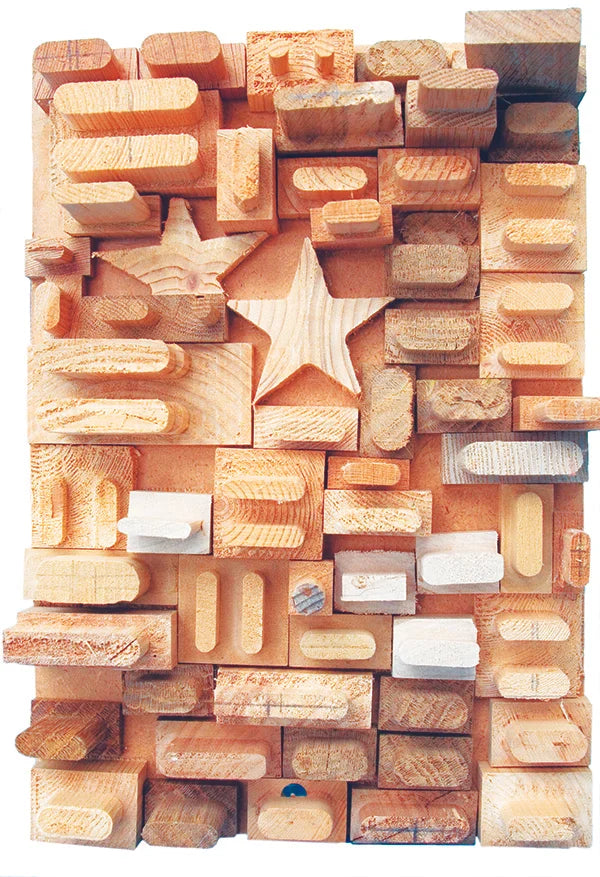
The Tenon Template
The Tenon Template has room for dowels and tenons of different sizes. Joining its islands makes longer tenons: place a peg and the angled stop in the Guide Rail for the back and front cuts, effectively doubling the template's length.
It assumes you're making tenons to fit mortises cut on the MR4 with 8mm, 10mm or 12.7mm straight bits. The tenons come in two gangs of paired tenons of equal length, for different widths of single or twin tenons, one gang thicker than the other.
On the smaller gang, an 8mm bit makes a 10mm tenon and a 10mm bit makes an 8mm tenon, single or twin, and with practice they're very quick to make. On the bigger gang, a half-inch (12.7mm) cutter makes 10mm tenons and a 10mm cutter makes half-inch tenons. It will also cut dowels integral with the rail.
The Dovetail Template
The Dovetail Template gives simple dovetails. The socket pitch is fixed in the template, so the work has to fit the spacing, but with the same spacing you can use different thicknesses of wood, with the right length of bit for each. Our HSS bits do the whole job.
The Half-Blind Template and drawer making
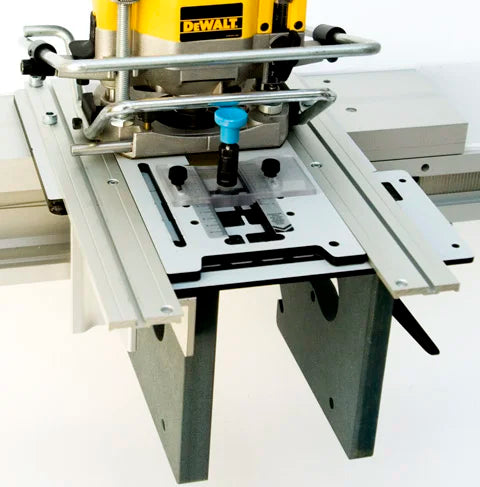
Next we set ourselves a template for lapped (half-blind) dovetails for drawers. Start here if you need to make a lot of drawers, each taking less than five minutes' jointing time.
The pitch is fixed, but the plate has two pitches, so you can choose the one closest to your drawer height. You lose a little flexibility and gain a lot of speed. Setting up takes a little time, but once done it makes perfect, light, strong, classic dovetailed drawers in different sizes, without compromising quality. The rounded corners of the router work are lost in the joint, leaving perfect lapped dovetails with no extra chisel work.
Secret dovetails
Secret dovetails have two important uses: jointing under veneer, so the end grain of the joint doesn't distort the veneer, and boxes whose grain or carving runs round from face to face and would be spoilt by visible joints. The Pathfinder is set up as before, but the Mitre Box first cuts a 45° angle on the outer corners of the board, then the lapped dovetail is built into the inner faces with the half-blind template.
The Blank Template
From there it was a short hop to a Blank Template for your own shapes, for toy making and so on. Going round a templated shape is as easy as it gets, so these shapes are quick and simple. Make your own from 3mm acrylic and glue them into the blank.